Hold a comparable busy-board sample from production approval until its component construction, any magnet-retention design and relevant testing have been reviewed against the agreed written specification. The Small Fish Montessori Busy Board Toys recall makes detachable magnets the mechanism to investigate—not a reason to assume every activity board contains them. Start by identifying the exact sample, materials, moving parts and packaging; document observable discrepancies, then route safety questions to a qualified laboratory before making the approval decision.
The useful outcome is a controlled sample decision: proceed to testing, request revision, hold or reject. A working spinner, attractive finish or convincing hand demonstration is not evidence that a magnet will remain captive under the applicable safety tests.
What did the June 25, 2026 Small Fish recall establish?
The June 25, 2026 U.S. CPSC recall identified detachable magnets as the ingestion hazard in Small Fish Montessori Busy Board Toys, model 2512JX02. CPSC stated that the recalled boards violated the mandatory safety standard for toys because magnets could detach. This is a finding about the named recalled product, not a finding about unrelated activity boards. CPSC recall
The recalled configuration was a wooden base with six removable, multicolored square panels: flipping mirror, abacus, finger spinner, spinning gear, rain maker and bead maze. Transfer the review questions only where a candidate has a comparable component or release mechanism—not merely because its name includes “Montessori” or “busy board.” CPSC product description
The published hazard is severe: swallowed high-powered magnets can attract one another or other metal objects inside the digestive system, potentially causing intestinal perforation, twisting, blockage, blood poisoning and death. That mechanism justifies focused retention questions; it does not establish a defect rate, determine an age grade or create a legal rule for other products or markets. Illinois public health notice
What should the first physical sample be compared against?
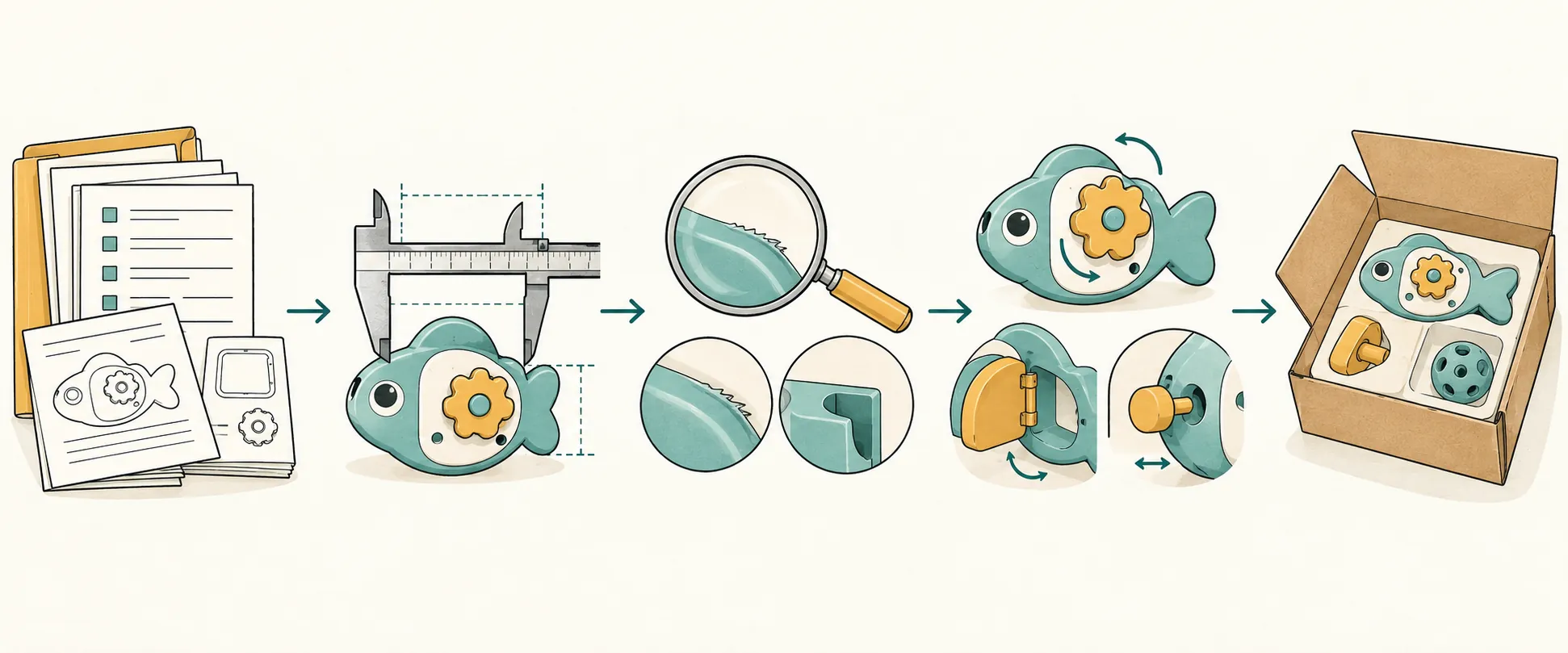
Compare the first physical sample with the agreed written specification and design requirements—not with an “approved sample” that has not yet been approved. Identify the drawing revision, component list, intended functions, material specifications, measurement points, finish requirements and packaging artwork before recording a pass or discrepancy.
Operate each intended control normally. Record binding, unexpected movement, panel separation, visible cracks, exposed adhesive, loose components, rough edges and deviations from the agreed finish. These are screening observations that can trigger correction or testing; they are not laboratory safety conclusions.
Map every magnet-containing component, if present, to a drawing location and retention detail. An exterior view cannot establish the absence of a concealed magnet. Request the component declaration and construction drawing; where necessary, arrange a separate engineering sample for controlled disassembly rather than altering the sample intended for subsequent testing.
Only after approval should a designated sample become the retained production reference. Keep it with the written specification and revision history so that an unnoticed physical feature does not become an accidental design requirement.
Montessori Lock Activity Learning Table: Sample Review Brief
| Exact item and review identity | Catalog item: BPF350566, Montessori Lock Activity Learning Table; catalog reference dated October 9, 2026. Before inspection, enter the supplier sample ID, sample revision, specification/drawing revision and intended destination market. Keep the sample identity on the review record and test submission. |
|---|---|
| Material and construction | Starting reference: catalog material ABS. Target: agree which components this describes and specify the other component materials. Observation: record visible construction, seams and finish, and compare the supplier component declaration with the specification. Signal: an unexplained material or joint change. Action: hold the affected approval item for engineering review; visual appearance alone does not verify resin identity. |
| Functions, panels and removable parts | Target: the agreed component list and intended movement of each lock or activity. Observation: identify every fitted, removable and loose supplied part; operate each intended function and record binding, unexpected release or separation. Action: request correction for a specification mismatch and route any safety concern for qualified evaluation. |
| Magnet presence, location and access | Target: a component declaration and location drawing stating whether magnets are used. Observation: map declared magnets to the physical sample and record exposed surfaces, covers, seams and possible release paths. Record a feature as not present only when the component mapping supports that conclusion. Action: apply magnet-specific review only where the construction contains a relevant mechanism. |
| Retention design and supplier questions | Request each magnet's dimensions, material/grade and strength specification; identify adhesive bonding, encapsulation or mechanical capture and how the surrounding panel is attached. Ask whether the magnet or its retaining cover is user-accessible and which part would have to fail for release. Compare the answer with the controlled drawing, not just a verbal assurance. |
| Dimensions and fit | Starting reference: catalog-listed size 36.9 × 30.8 × 25 cm. Target: agree measurement points and any purchasing tolerances before inspection. Observation: enter the measured dimensions and check intended fit and alignment. Signal: a measurement outside the agreed target or interference during operation. Action: obtain a corrected sample or an explicitly approved specification revision. |
| Finish and assembly condition | Target: the agreed surface, edge and assembly requirements. Observation: document cracks, burrs, rough edges, gaps, loose fasteners and adhesive residue where visible. Action: segregate the affected sample for review; do not conceal a discrepancy by repairing it before the original condition is recorded. |
| Packaging, instructions and age evidence | Starting reference: color-box packing. Target: the agreed pack contents, product identity, instructions, artwork and destination-specific label review. Observation: compare the actual box, inserts and supplied parts with that target. Request age-grading evidence for this exact construction; neither the Montessori name nor magnet presence establishes age suitability. |
| Testing-required flags | Qualified evaluation required for safety conclusions about magnet retention, any released magnet's relevant size/strength characteristics, applicable small-part hazards and other requirements identified for the product. Ask the laboratory to confirm the applicable test scope and the match between the submitted construction and any existing report. |
| Proposed decision and approval responsibility | Decision: hold production approval; authorize specification reconciliation and relevant test-scope review. The responsible product-development buyer records their name and actual review date. Engineering closes construction discrepancies; the designated safety/compliance reviewer evaluates the relevant test evidence before the authorized approver signs the final disposition. |
| Follow-up closure | For each issue, record the specified target, actual observation, supplier response, corrective action, owner and closure evidence. Require closure before the affected approval stage. Link any revised sample and drawing to the original issue, then record the approver, closure date and remaining conditions. |
Which questions require qualified testing rather than a hand check?
Whether a magnet remains captive under applicable toy-safety tests requires qualified testing; normal operation and visual inspection cannot establish that result. Do not substitute an improvised hand pull or pliers check for the specified laboratory procedure, and do not derive an age grade from a buyer's hand inspection.
Send the laboratory the exact sample identity, intended use, proposed age grading, component drawings and destination market. Ask which retention, accessibility and other relevant evaluations apply to that construction, including how any released magnet would be assessed. The recall is a reason to ask these questions, not a substitute for defining the candidate's test scope.
Ask the supplier: “Which report covers this construction, and how are its tested materials, magnet, retention method and panel assembly linked to this revision?” Evaluate the actual coverage rather than relying on a generic certificate heading or an assumed universal report expiry.
Keep U.S., EU and other destination document reviews separate. The U.S. recall does not determine another market's requirements. Request notification before changes to the magnet, adhesive, enclosure, panel attachment or other relevant construction, then have the change assessed for its effect on specification and test coverage.
When do baby bath toy drainage and cleaning questions belong in this review?
Baby bath toy drainage and cleaning questions belong in the review only when the exact candidate is intended for wet use; an early-learning category or ABS catalog entry does not make a busy board a bath toy.
For a wet-use design, compare the sample with its agreed cleaning instructions and water-management design. Ask where water enters, how it leaves, which cavities can be opened or reached for cleaning, and whether reassembly changes access to a retained component. Following the specified cleaning method, record trapped water, inaccessible residue, cover movement, corrosion or joint deterioration if observed.
If a magnet is enclosed near a water path, request the section drawing and ask the laboratory whether the intended wet-use and cleaning conditions affect the relevant evaluation. Treat visible drainage and cleaning access as design observations—not proof of microbial safety, magnet retention or long-term durability. Do not immerse a dry-use activity board simply to extend this screening exercise.
What happens after a discrepancy, and when can bulk comparison begin?
A discrepancy should lead to a documented correction, authorized specification change or rejection—not an informal promise that production will be different. Preserve the original observation, identify the affected requirement and assign the follow-up owner before reviewing a replacement sample.
Approve for qualified testing when the sample identity and construction are sufficiently defined for a meaningful evaluation. Request revision when a correctable design or specification mismatch remains. Keep production approval on hold while consequential construction or test conditions remain open; reject a candidate when the proposed design is unacceptable or the supplier declines the required correction.
After final sample approval, identify and retain the approved production reference. Bulk inspection should compare production with the current written specification, relevant test coverage, approved reference and authorized change records. A retained sample complements those controls; it is not the only valid basis for comparison.
Record photographs where useful, particularly for location-specific discrepancies, but a missing photograph alone does not invalidate otherwise adequate measurements and written observations. Traceability supports the review; it does not by itself detect an undisclosed change. Sample approval remains a purchasing decision, not a safety certification.