A shape review on a silicone teether should preserve four things in writing: which component can separate, under what condition it separated, which model and units are in scope, and how many consumer reports existed at the time of the decision. The Skip Hop Elmo teether recall (CPSC 26-739, announced September 3, 2026, model 9R263210) makes this concrete. According to CPSC, the reported failure involves the black eyes detaching when the teether is frozen, on roughly 22,660 US units and about 3,177 Canadian units, after four consumer reports and no reported injuries. CPSC describes the resulting choking risk as capable of serious injury or death.
This is the factory-visit version of that lesson: what a baby-toy brand developer or OEM/ODM sourcing manager should check at the door, on the sample, and in the records taken away. It is a baby toy test document checklist by market question as much as a shape question, and the answer is that shape, condition of use, and market evidence have to travel together. This is an external public recall; nothing here is presented as a customer, supplier, or factory case.
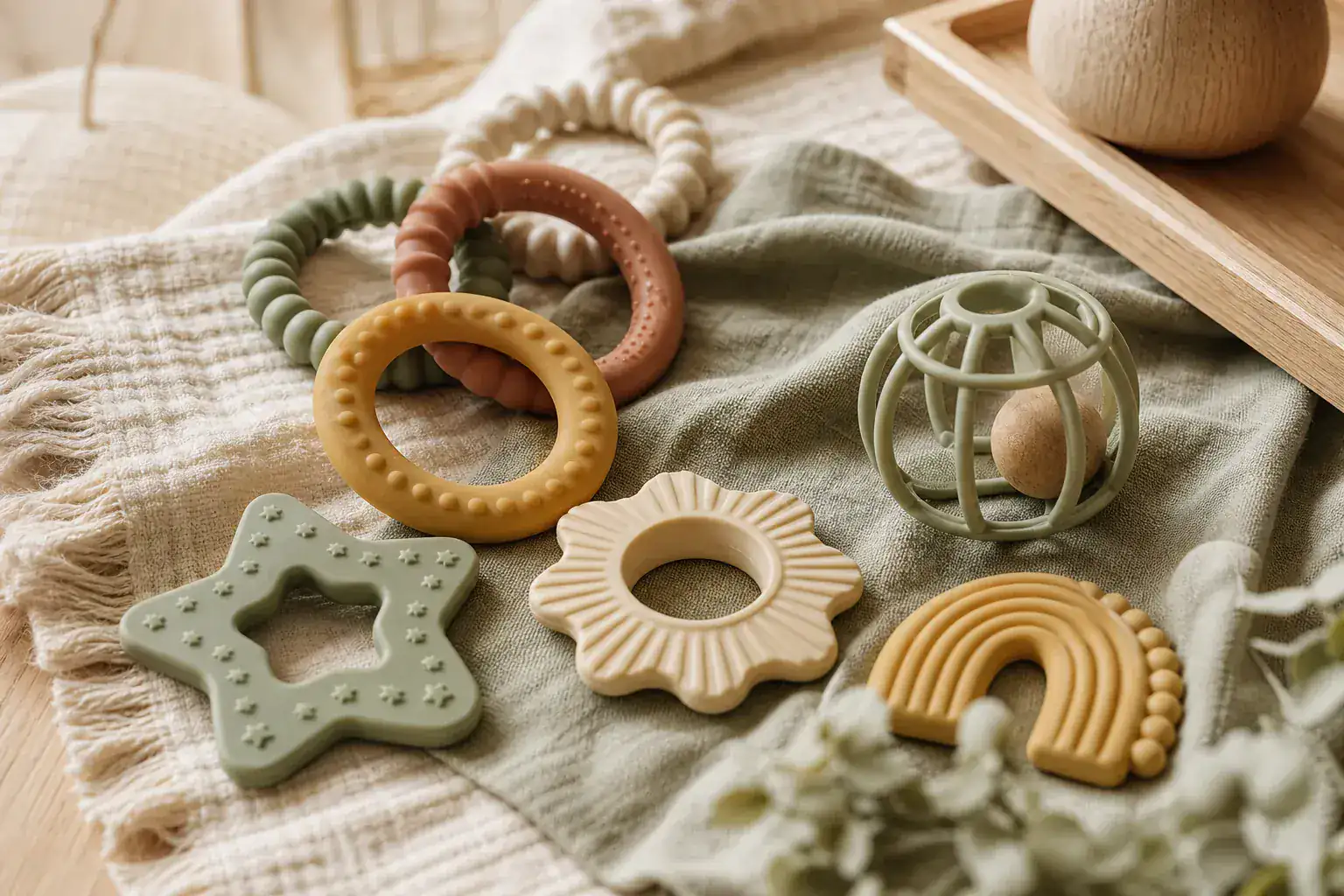
At the door: which document gets checked first, and what stops the visit
At the door, ask for the SKU-specific age grade and intended-use statement before anything else. If the factory cannot show which model number, which market, and which age band a teether is built for, the rest of the visit has no anchor — and you should not continue on goodwill. The Elmo recall is a model-level event: model 9R263210 only, sold at Carter's stores nationwide and online through Carter's and Skip Hop from January 2025 through March 2026 at about $12. Every other Elmo or Skip Hop teether sits outside that scope. If a supplier answers a recall question with 'our teethers are fine,' you have learned nothing about scope discipline.
Next, the test matrix. A useful request identifies market, standard edition, product configuration, age grade, and laboratory route in one document. Two operational consequences follow. First, the lab should be chosen after the market and test scope are defined, because not every lab or site can perform every toy method. Second, if the product is a teether, the condition of use has to appear in the matrix: room temperature, refrigerated, frozen. The reported failure in the Elmo case is tied to freezing, so a protocol that only tests at ambient temperature never touches the reported failure mode.
Then the release gate. A shipment should be blocked when a required test, marking, document, or critical inspection is incomplete or has an unresolved failure. Sorting suspect units out of a finished lot is containment. Corrective and preventive action has to address the cause of the defect and verify effectiveness — otherwise the same shape problem returns on the next mold, the next colorway, or the next component supplier.
On the sample: which part gets opened, and the question asked right after
On the sample, go straight to the smallest attached component on the shape — the eyes, pupils, nose, cheeks, or any insert that is not molded as one piece with the body. Press, twist, and pull it. Then put the teether in a freezer and repeat. The Elmo case documents that the black circles in the eyes can detach when the teether is frozen; it does not document why. Treat the second half of that sentence as a rule, not a gap: the public record reports the detachment and the recall, and it does not establish a manufacturing cause. Adhesive failure, bonding, material grade, mold design — none of that is in the notice. If your supplier volunteers a confident cause on the spot, ask for the test or inspection record behind it.
The question to ask immediately after handling the sample is about the shape change history: has this component geometry, the eye insert, or its attachment method changed since the last approval, and is there a sample retained from each version? A shape review that keeps only the current sample cannot tell you what moved. Keep the approved sample, the revision record, and the date of each change. If a revision has no retained sample, mark it unknown rather than reconstructing it from memory.
For plasticized components, the chemical side runs in parallel. A phthalate test should cover the accessible plasticized components and the current restricted list for the target market. That matters for silicone bodies, soft grips, and any plasticized part a mouth can reach — and it is a different test from a detachment or small-parts check, so one report does not substitute for the other. Wooden and ABS shape toys follow the same logic at a different material layer; the review question is always which accessible component, under which condition, against which market list.
A shape review is also a small-parts review. CPSC framed the Elmo detachment as a choking risk capable of serious injury or death, which is the correct vocabulary for a part that can come loose in a mouth. Record the measured size of the detached component as tested, not as designed. Designed dimensions and as-produced dimensions are not the same number, and the recall record will care about the second one.
Before leaving: the records to take away, and what to write as unknown
Before leaving, walk out with five documents and one photo set. The documents: the SKU-specific age grade and intended-use statement; the test matrix naming market, standard edition, configuration, age grade, and lab route; the current test reports with the lab's scope visible; the shape revision record with retained samples referenced by date; and the release-gate procedure showing what blocks a shipment. The photo set is of the actual sample you handled, including the smallest attached component, taken before and after the freeze cycle.
Two fields are easy to lose and expensive to reconstruct. The first is the condition of use: if the product will be frozen, that condition belongs in the test request, not only in the instruction leaflet. The second is market packaging. Canada's Toys Regulations include a dedicated packaging section, so toy packaging needs a Canadian review separate from the toy body — a teether that clears a US review is not automatically cleared for a Canadian shelf. Incoterms do not help here: FOB, CIF, DDP and similar terms allocate trade responsibilities but do not certify the toy or replace CE, CPC, UKCA or other market evidence.
If any of the five documents is missing, write unknown and name the owner of the follow-up. Do not fill the gap with a plausible story about glue, molds, or supplier quality. The public Elmo record supports a specific scope — model 9R263210, a frozen-use detachment of the black eye components, about 22,660 US units and roughly 3,177 Canadian units, four consumer reports, no injuries reported at announcement, a January 2025 to March 2026 sales window, and a refund via gift card at The William Carter Company brand stores. It does not support a cause. A shape review that preserves scope and refuses to invent cause is the version that survives an audit, a customer question, and a recall notice.
FAQ
What exactly did the Skip Hop Elmo teether recall cover?
CPSC recall 26-739, announced September 3, 2026, covers the Skip Hop Baby Sesame Street Elmo Silicone Teether, model 9R263210 — approximately 22,660 units in the US and roughly 3,177 in Canada, sold at Carter's stores nationwide and online through Carter's and Skip Hop from January 2025 through March 2026 for about $12. The hazard is the black eye components detaching when the teether is frozen, which CPSC describes as a choking risk capable of serious injury or death. It is a model-level recall, not a brand-wide one.
Does the recall tell us the manufacturing cause?
No. The public record documents that the black circles in the eyes can detach when the teether is frozen, and that four consumer reports had been received with no injuries reported at announcement. It does not establish an adhesive, bonding, material, or mold cause, and any supplier or article that names one is going beyond the evidence. For a shape review, keep the documented failure mode and the reported scope, and treat cause as an open item until a test or inspection record closes it.
What should a teether test matrix include for the US or EU market?
The requested test matrix should identify market, standard edition, product configuration, age grade, and laboratory route. Add the condition of use explicitly — ambient, refrigerated, and frozen — because a frozen-use detachment will not appear in a room-temperature protocol. Select the lab after the market and scope are defined, since not every lab or site can perform every toy method, and keep phthalate testing on the accessible plasticized components separate from detachment and small-parts checks.
What documents should I take away from a factory visit on a silicone teether?
Five documents and one photo set: the SKU-specific age grade and intended-use statement; the test matrix naming market, standard edition, configuration, age grade, and lab route; current test reports with the lab's scope visible; the shape revision record with dated retained samples; and the release-gate procedure showing what blocks a shipment. The photos should show the smallest attached component before and after a freeze cycle. If a document does not exist, record it as unknown with a named owner rather than reconstructing it.
Does a low consumer complaint count mean a component is safe?
No. Four detachment reports preceded the Elmo recall, and no injuries had been reported at announcement — the action still covered more than 22,000 US units. Low complaint volume reflects what reached the brand, not how a component behaves under foreseeable use such as freezing, biting, twisting, and pulling. Judge the component on the test condition and the retained sample, not on how quiet the complaint inbox has been.
Does a US recall check clear the same product for Canada?
No. Canada's Toys Regulations include a dedicated packaging section, so packaging needs a Canadian review separate from the toy body, and the same product can require different evidence in each market. Incoterms such as FOB, CIF, or DDP allocate trade responsibilities but do not certify the toy or replace CE, CPC, UKCA, or other market evidence. Treat each destination as its own document set.
Sources
- #0188 Skiploom
- A Complete Guide To Evolving Skiploom Tips Conditions And Strategies
- Skip Hop Elmo Teether Choking Injury & Death Lawsuit Lawyers
- Skip Hop Elmo Teether Recalled Nationwide—See If Yours Is Affected
Related Products & Categories
Bring the checklist to your next factory visit
If you are developing a silicone teether or another mouth-contact baby toy and want the door-to-departure document set reviewed against your target market, send us the model, age grade, and destination. We can walk a sample through the freeze-cycle check and the record list above — as one factory among the ones you should compare, with the scope and the unknowns written down. For reference on how we document materials and age grading, see our wooden baby toys line and ask for the current test matrix behind it.