Before approving a plush baby toy for US/EU production, document every structural seam in a seam-location register linked to the approved sample revision and verification evidence. Your plush baby toy fabric, filling, and seam checklist should separate agreed construction targets from actual observations, identify who checked each seam, and record approval conditions. Release production only when the specified construction and supporting evidence are accepted; otherwise, return the affected items for correction with a named owner and due date.
This is a purchasing and production-control record, not a safety certificate. Record the intended destination, age group, and intended use for the specific product. A baby-toy category name, soft appearance, or fabric description does not establish infant suitability.
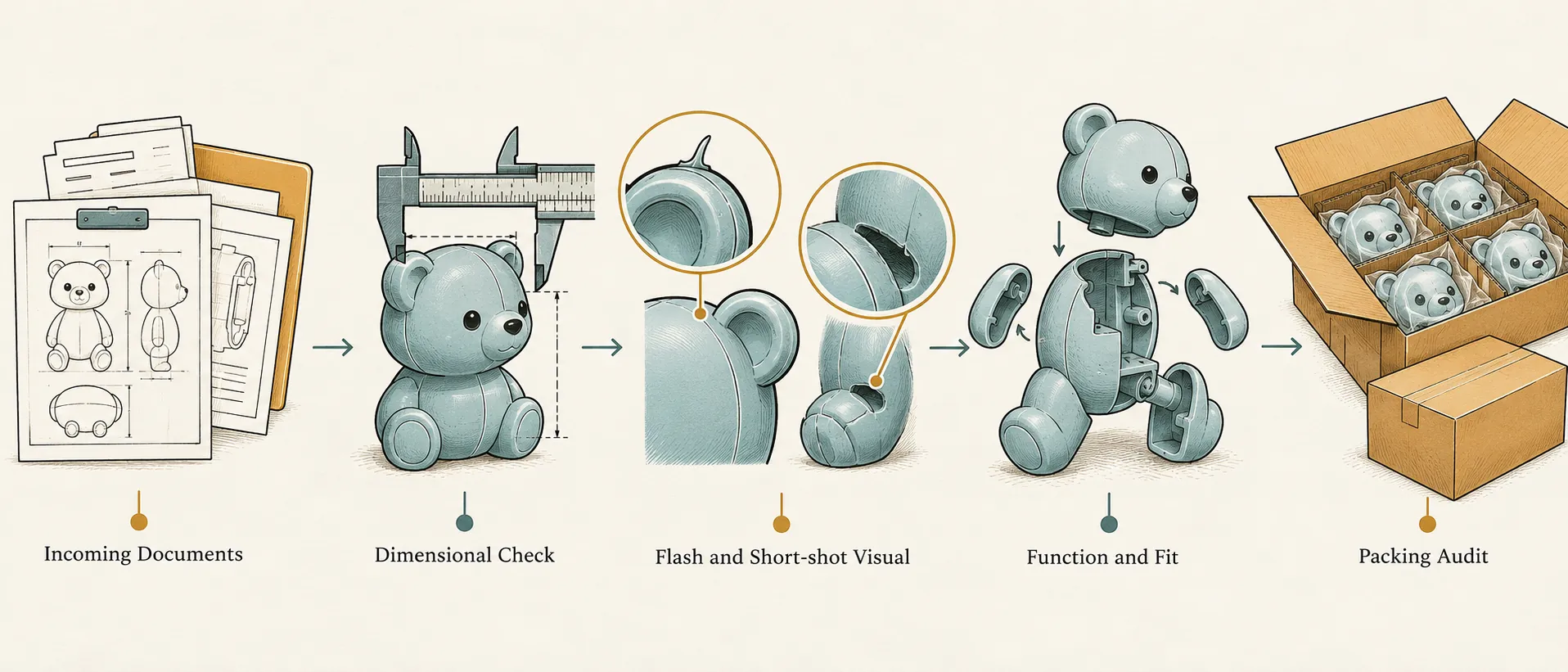
Which seam locations should the buyer record?
Record all structural seams, giving separate identifiers to attachment joints, the stuffing closure, and other locations that need distinct construction or verification instructions.
Include limb-to-body attachments, ear and tail bases where present, body-panel joins, and the final opening closed after filling. Add seams around access openings and zipper end stops only if those features exist in the approved design. A manufacturer’s stitching guide identifies these attachment and closure locations for particular attention; it is practical guidance, not a universal required seam list. Plush stitching guide
“Body seam” is not a usable location description. State the viewing orientation, adjoining panels, start and end landmarks, and the associated drawing or photograph. For example, a location description might read “lower-back stuffing closure, between the two marked endpoints in rear-view photograph C.” This is an illustrative naming convention, not a product specification.
Show left and right attachments separately when they need independent checks. Identify which stitches close or support the structure and which are decorative; a neat surface photograph should not stand in for evidence of a concealed joint.
Which documents should be agreed before the purchase order?
Before the purchase order, agree the SKU specification, seam construction, sample reference, verification plan, and draft packaging identity; do not request final shipment quantities at this stage.
The following is a buyer-proposed document package. Use an inquiry or development reference before an order exists, then add the purchase-order reference when issued. A sourcing guide published July 13, 2026, recommends documenting fabric, filling, stitch position, labels, and packaging in the sample record. Stuffed-toy sourcing guide
| SKU scope and material specification | Owner: supplier technical team; buyer product developer approves. Useful fields: product identity, size/version, intended US/EU destination, SKU-specific intended-use and age rationale, fabric and backing identifiers, filling specification, thread specification, and customization scope. Mismatch consequence: the sample and quotation may describe different constructions; reconcile the affected material or design before approval. |
|---|---|
| Seam-location register and annotated construction drawing | Owner: supplier sewing technician or technical designer; buyer technical approver accepts. Useful fields: seam identifiers, exact locations, construction details, material interfaces, reinforcement, revision, and linked evidence. Mismatch consequence: the factory has conflicting instructions about where or how to sew; correct the affected seam instruction before production release. |
| Sample approval and verification-evidence record | Owner: supplier sample team maintains sample identity; buyer quality or product lead signs the approval. Useful fields: physical sample identifier, revision, approval date, seam photographs, measured or observed results, exceptions, and disposition. Mismatch consequence: approval may refer to a different sample or leave a concealed construction unverified; resolve the specific identity or evidence discrepancy. |
| Verification plan and report-coverage review | Owner: buyer quality lead coordinates with supplier quality staff and the testing provider where applicable. Useful fields: seam-specific checks, methods, acceptance criteria, sampling, responsible checker, planned timing, report identifiers, tested construction, and destination scope. Mismatch consequence: a check or report may not address the seam being approved; determine the additional review or verification needed. |
| Draft label and packaging specification | Owner: buyer packaging or artwork lead; supplier confirms implementation. Useful fields: matching product identity, artwork revision, intended-use and age wording for review, sewn-label location, and any label insertion within a structural seam. Mismatch consequence: the label or package may identify another version, or a label insertion may alter an approved joint. Resolve the affected identity or seam detail before release. |
What belongs in the SKU-level seam-location and verification record?
Use one record header for the product and a separate entry for each seam, keeping specified targets beside observations and evidence references.
The reusable fields below are proposed purchasing controls, not prescribed regulatory forms. Enter the actual agreed values and observed results rather than copying a generic “approved” status across all seams.
| Product and revision identity | Record the buyer product reference, supplier model reference, size/version, destination market, specification revision, approved sample identifier, and sample approval date. Add the purchase order when issued. Reconcile these identifiers across the drawing, sample record, inspection record, and relevant report descriptions; document any equivalent naming. |
|---|---|
| Seam ID and physical location | Assign a unique seam identifier. Specify the adjoining panels or components, left/right orientation where relevant, start and end landmarks, and annotated drawing or photo reference. Observation: confirm that the checker located the same seam on the identified sample. |
| Fabric and filling interface | Target: identify the actual fabric layers, backing or lining, and filling specification relevant to the seam. For the stuffing closure, state the agreed finishing condition, including keeping filling clear of the stitch path. Observation: identify the sample materials and record any visible trapped filling or exposed filling. |
| Stitch and thread construction | Target: record stitch type, thread specification, stitch-density target and units, plus the agreed measurement location and tolerance. Observation: record the stitch construction and measured density at that location, with the evidence reference. Do not substitute “strong stitching” for a reproducible instruction. |
| Seam allowance and closure geometry | Target: specify seam allowance and, where used, closure overlap or folded-edge geometry. Define exactly which edges or stitch lines are measured. Observation: record the measured construction on an accessible sample or a linked construction specimen. |
| Reinforcement and seam ends | Target: identify reinforcement locations and construction, including any double sewing, backstitching, or other agreed end securing. Observation: record what is visible or demonstrated in the linked construction evidence, including departures from the target. |
| Verification method and acceptance criterion | Name the visual, dimensional, construction, or mechanical check. Reference its procedure and agreed acceptance criterion. For instrumented testing, identify the method, setup, conditioning where relevant, specimen, and report. Keep buyer screening criteria separate from applicable safety-test requirements. |
| Observed result and evidence | Record the actual observation or measurement, sample identity, check date, checker, and evidence filename or report reference. Preserve the distinction between a sample result and later production inspection. “Pass” alone does not explain what was checked. |
| Decision and responsible approval | State approved, approved with defined conditions, or revise and resubmit. Name the responsible buyer approver and approval date. Define whether the decision releases the sample, the seam specification, production, or shipment; these are different decisions. |
| Open conditions and follow-up closure | For each unresolved item, record the required action, responsible owner, due date, and affected approval hold. Close it with the corrective evidence reference, reviewer, closure date, and final disposition. Retain the earlier record rather than replacing it without a revision trail. |
What evidence verifies the approved seam construction?
Use location photographs to establish where a seam is, construction evidence to show how it is made, and check records to show what was actually observed or tested.
For each seam, retain an overall view with the seam marked and a close-up linked to the same sample. Concealed allowances or reinforcements may need pre-closure photographs, a construction specimen, or a sacrificial sample examination. Identify that evidence separately and explain its relationship to the finished approved sample. An exterior image cannot establish an internal allowance.
Fix numeric targets through agreement and verification, not by treating a supplier article as a standard. For example, one manufacturer recommends 8–12 stitches per inch for main-body lockstitch seams and at least 15 mm overlap at stuffing closures. Those figures are that manufacturer’s guidance—not universal legal limits or proof of suitability for your fabric and joint. If adopting an overlap target, define the measured geometry on the drawing. Plush stitching guide
Check corners, limb joints, and other load-bearing locations for opened stitching or damage, while keeping commercial inspection separate from safety testing. A factory checklist updated October 27, 2026, recommends those location-specific checks and agreeing sampling, defect classifications, acceptance criteria, and nonconforming-goods handling before delivery. Set these controls before production release so the factory can plan the checks. Plush inspection checklist
Where a test report supports approval, reconcile its product description, photographs, materials, construction, method, and scope with the proposed product. The July 13, 2026 sourcing guide likewise recommends matching reports to the actual product, material, standard, and order scope. This is a document-review principle, not a determination of which tests US or EU law requires. Stuffed-toy sourcing guide
How should buyers reconcile mismatches and approve changes?
Resolve a mismatch at the affected seam and revision, then document the recheck and approval; neither a broad sample approval nor an unrelated report closes that discrepancy.
Consider an illustrative document mismatch: the seam register places the stuffing closure on the lower back, but the approval photograph marks a side-panel closure. Compare the product identifiers, sample revision, drawing, and photograph first. Correct an annotation error if that is the cause; if the closure moved, update its construction instruction and determine which checks must be repeated. The discrepancy alone does not establish a failed seam.
Require a change request when seam location, stitch construction, thread, fabric/backing, reinforcement, or the filling process affecting closure changes after approval. Record the old and proposed conditions, affected seam identifiers, reason for change, supporting sample or specimen, verification decision, and responsible approver/date. Recheck the affected construction and review whether existing evidence still covers it.
Assess report coverage, applicable retest duties, and buyer or retailer policies separately. Do not assume a new internal product code automatically invalidates a report, that every later batch needs a new report, or that all reports have one universal expiry period.
Use conditional approval only with explicit boundaries. If a condition concerns concealed seam construction or necessary verification, keep that affected production release on hold until closure. An administrative correction need not erase otherwise valid evidence, but its resolution should remain traceable.
What should be added during production and before shipment?
During production, add records showing the identified order was checked against the released seam specification; before shipment, add the final inspection disposition and actual shipment documents.
Link production inspection records to the purchase order or lot, seam-register revision, approved sample, checked units, methods, observations, dates, and checker. Record deviations and corrective-action closure rather than assuming sample approval also approves the production run.
At shipment review, reconcile the final inspection record and any applicable final testing evidence with the released construction. Finalize the packing list and commercial invoice using actual shipment details at that stage—not as prerequisites to an initial purchase order. Keep draft packaging approval separate from confirmation of the packaging actually used.
The resulting file should let another reviewer find each seam, understand its agreed construction, locate the relevant evidence, and identify who authorized release. It supports traceability; it does not by itself prevent an undisclosed change, prove US/EU safety compliance, or guarantee that a seam cannot fail later.