Accept a wooden-toy finishing control system only when batch records connect the approved coating and substrate to traceable production samples, completed checks and authorized changes. For wooden baby toy coating and finish questions, separate non-negotiable evidence gates from scored preferences: an unresolved critical gap blocks acceptance, however attractive the sample. Compare batch records with retained samples, then compare those samples with the approved reference using the agreed method. Record acceptance, conditional acceptance or rejection with named owners and dated closure evidence.
This is a procurement assessment of finishing controls—not certification, a complete factory audit or a substitute for product-specific safety testing. Establish the exact toy, intended age, intended use and destination market separately. A wooden construction, coating description or attractive sample does not establish infant suitability.
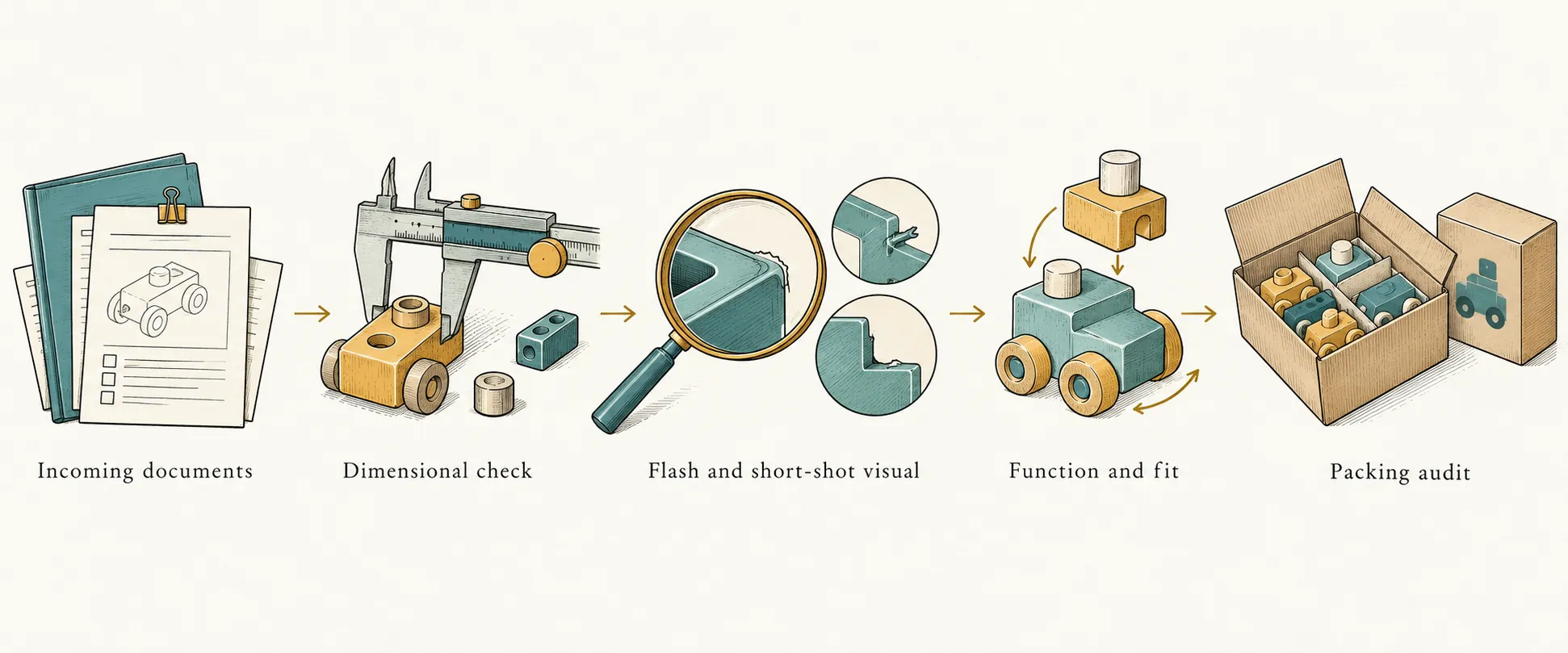
Which Finish-Control Failures Should Stop Acceptance?
Agree the gates before reviewing the supplier's presentation. Material identity must connect the approved coating system—including relevant primer, colorant and topcoat—to the production batch and approved substrate. Change control must cover substitutions and changes to preparation, application, curing, texture or gloss that fall within the agreed reapproval rules.
Execution evidence must show what was done, not merely describe what the procedure requires. Request the applicable preparation and application records, curing or drying records, and inspection entries showing the method, agreed limit, actual result, disposition and responsible signoff. Include adhesion, hardness or gloss checks where the approved specification requires them; they are not interchangeable measures or automatically mandatory for every finish.
Keep three statuses distinct: pass, demonstrated failure and unresolved evidence. A missing inspection entry does not prove that the finish failed. It does mean that the buyer cannot close that particular evidence gate. Neither a procedure nor a signed form alone establishes that every production unit conforms.
How Should Batch Samples Be Compared With the Approved Finish?
Use a two-way comparison: connect each sample to its production record, then compare that sample with the approved reference under a controlled, documented setup.
Request the coating material and lot identifiers, specification revision, substrate identity, preparation and application records, drying or curing conditions, inspection records, deviation approvals and sample-selection record. The sample record should identify the production batch, selection point, selection date and retained-sample identifier. Agree the sampling coverage before production; do not let one specially selected sample stand for an entire batch without an agreed basis.
Record targets and observations separately. The target states the approved finish, method and acceptance boundary. The observation states what the reviewer saw or measured, under which conditions, and on which sample. Photographs help locate differences, but uncontrolled photographs should not decide a close color or gloss dispute.
X-Rite's guidance on reflective surfaces, accessed October 21, 2026, explains that measurement geometry and specular reflection affect color comparisons. Agree instrument geometry and specular mode where instruments are used, and record the surface finish alongside the result. A changed gloss or texture warrants a renewed color comparison rather than an assumption that the old reading remains comparable. X-Rite
A coated test panel can support process assessment, but document its relationship to the toy's substrate, preparation, coating layers and curing conditions. Do not silently substitute a panel for a finished part when the agreed check calls for the actual part.
Finish Batch and Sample Comparison Record
| C1 — Approved coating and substrate identity | Class: critical. Required evidence: approved finish system, material issue record and substrate identification. Batch reference: B-01 material record M-01. Sample reference: S-01–S-03 and R-01. Target: coating identities and substrate link to F-01 revision C. Observation: both hypothetical packages contain the matching material and substrate cross-references. Result: A passes; B passes. Gap: none identified for this criterion. |
|---|---|
| C2 — Authorized finish changes | Class: critical. Required evidence: revision history and approval covering changes subject to reapproval. Batch reference: B-01 change record CH-01. Sample reference: S-01–S-03 against R-01. Target: production revision has documented authorization. Observation: A connects the production revision to its approval; B cites an earlier revision without the intervening authorization. Result: A passes; B is unresolved. Gap: B requires the revision-to-approval link or corrective evidence addressing an unauthorized change. |
| C3 — Completed process and inspection records | Class: critical. Required evidence: preparation, application, drying or curing records, plus required inspection methods, limits, results, dispositions and signoffs. Batch reference: B-01 process record P-01 and inspection record I-01. Sample reference: specimen links in I-01 to S-01–S-03. Target: all required record fields and referenced attachments are present and connected. Observation: both hypothetical packages contain the required fields and attachments. Result: A passes documentary completeness; B passes documentary completeness. Gap: none for completeness; this row does not determine technical test acceptance. |
| C4 — Traceable samples and comparable review conditions | Class: critical. Required evidence: sample-selection record and comparison setup. Batch reference: B-01 selection record SEL-01. Sample reference: S-01–S-03, R-01 and comparison record CMP-01. Target: agreed selection points are documented and the comparison uses the specified visual or instrumental setup. Observation: both hypothetical packages identify selection points, reference identity and comparison setup. Result: A passes; B passes. Gap: none identified for this documentary criterion. |
| W1 — Cross-reference clarity | Class: weighted preference; illustrative weight 40. Required evidence: navigable index linking materials, production, samples and inspections. Batch reference: B-01 evidence index IDX-01. Sample reference: indexed S-01–S-03. Target for full preference score: direct, consistent links without manual reconstruction. Observation: both hypothetical packages provide direct links. Result: A scores 2/2, contributing 40 points; B scores 2/2, contributing 40 points. Gap: none. |
| W2 — Within-batch visibility beyond the agreed minimum | Class: weighted preference; illustrative weight 30. Required evidence: sample-location map and supplementary comparison records. Batch reference: B-01 supplementary map MAP-01. Sample reference: S-01–S-03. Target for full preference score: an integrated view of the agreed production intervals, beyond the minimum traceability gate. Observation: A provides the required links but only a partial consolidated view; B provides the integrated view. Result: A scores 1/2, contributing 15 points; B scores 2/2, contributing 30 points. Gap: A needs a consolidated presentation, not additional sampling unless separately agreed. |
| W3 — Reviewable history of finish-control changes | Class: weighted preference; illustrative weight 30. Required evidence: summary of prior comparable control reviews, with revision boundaries identified. Batch reference: B-01 review-history index HIST-01. Sample reference: current samples S-01–S-03 linked to the current comparison. Target for full preference score: a consolidated history that keeps different finish revisions distinguishable. Observation: A supplies individual records without a complete summary; B supplies the consolidated history. Result: A scores 1/2, contributing 15 points; B scores 2/2, contributing 30 points. Gap: A needs the summary; B's presentation score does not resolve its missing change authorization. |
How Should Weighted Preferences Affect the Decision?
Score preferences only after reviewing the critical gates, and never let a high total cancel an unresolved critical item.
For the hypothetical record above, use a proposed buyer scale of 0 for an absent preference feature, 1 for partial provision and 2 for full provision. Calculate each contribution as weight × score ÷ 2. Package A totals 70/100; Package B totals 100/100. These are document-usability scores—not safety ratings, compliance thresholds or predictions of defect rates.
An illustrative purchasing rule is: all critical gates passed and at least 80 points permits acceptance of the control system; all gates passed and 60–79 points permits conditional acceptance with defined improvements; below 60 points requires improvement before acceptance. Any unresolved critical gate blocks acceptance regardless of score. Set the rule before submissions arrive.
Within-tolerance appearance consistency can also be a weighted preference if the buyer wants it. Crossing a mandatory finish limit is different: it remains a critical failure, not an opportunity to deduct a few points.
Accept, Accept With Conditions or Reject
| Package A — Conditional acceptance | Decision date: October 20, 2026. Responsible approver: buyer quality manager. Basis: C1–C4 passed documentary review; weighted score 70/100. Conditions: consolidate the existing within-batch comparison map and the revision-separated review history. Owner: supplier quality lead. Due date: October 23, 2026. Scope restriction: documentary control-system acceptance only; product-release checks remain separate. |
|---|---|
| Package B — Reject pending corrective evidence | Decision date: October 20, 2026. Responsible approver: buyer quality manager. Basis: C2 unresolved; weighted score 100/100 cannot override that gate. Required action: establish whether the production revision was authorized and supply the supporting approval link; if not authorized, submit the corrective disposition and required reapproval evidence. Owner: supplier quality lead. Due date: October 23, 2026. Closure rule: buyer quality manager must reassess C2 before acceptance. |
| Package A — Dated condition closure | Evidence received: MAP-01 revision 2 and HIST-01 revision 2, dated October 23, 2026. Review observation: the consolidated map and revision-separated history satisfy the original W2 and W3 targets without changing the sample identities or finish specification. Reassessment: W2 and W3 each score 2/2; total becomes 100/100. Closure approved by buyer quality manager on October 24, 2026. Final decision: accept the documentary finishing control system within the stated scope; retain the original conditional decision and closure evidence. |
What Evidence Closes a Finish-Control Condition?
Close a condition only when dated evidence satisfies the same criterion that created it and the responsible approver records the reassessment.
A promise to update the file is not closure. Retain the original target, observation, decision, owner and due date alongside the revised evidence and approval date. If the corrective action changes the coating, substrate, process or reference sample, identify which earlier comparisons need reconsideration rather than simply replacing the old document.
A traceable record supports a defensible purchasing decision. It does not by itself reveal an undisclosed substitution, establish long-term process capability or prove every unit conforms. Keep control-system acceptance, batch disposition and product safety release as distinct decisions.