Choose a digital render to approve visual direction; choose a representative physical prototype when the decision depends on touch, actual finish, movement, or fit. In the baby toy OEM sample approval process, use both in sequence when an attractive on-screen design still needs material or functional confirmation. Approve each attribute separately against a named design revision: accepting proportions does not accept softness, approving color placement does not accept actual color, and neither format alone establishes safety compliance.
A render is an image of a model, not a measurement of a manufactured object. Its usefulness depends on the underlying geometry. Product-modeling guidance updated July 24, 2026, emphasizes that wall thicknesses, fillet radii, seams, and hardware clearances must reflect intended manufacturing dimensions rather than artistic guesses. Request the drawing or CAD reference behind the image before closing a dimension-dependent visual decision. 3D Product Modeling and Rendering
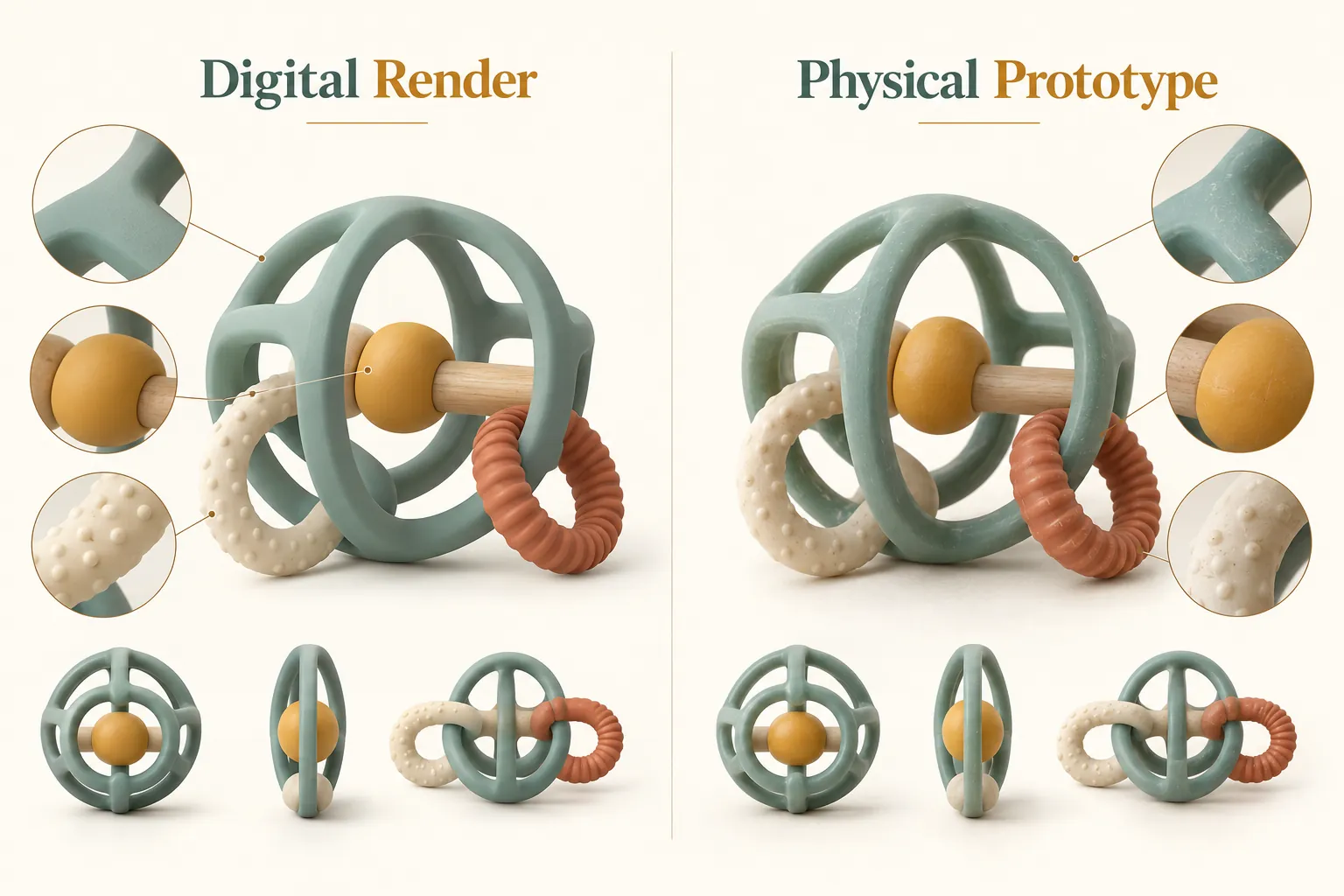
Which design decisions can a render or physical prototype support?
| Form and proportion — render first | Render: compare silhouette, feature placement, and relative proportions across consistent views. Physical prototype: judge actual scale in the hand. Close visual direction only when the model is tied to the intended drawing revision; choose physical review if perceived size or handling is the unresolved question. |
|---|---|
| Dimensions and clearances — both, with different evidence | Render: communicate geometry supported by dimensioned CAD or drawings; the image itself is not dimensional evidence. Physical prototype: measure the sample and inspect actual interfaces. Select physical measurement when the question is whether the object, rather than the model, meets a specified dimension. |
| Color and finish — render to narrow, physical to confirm | Render: choose color placement and compare proposed matte or gloss directions. Physical prototype: judge actual color, texture, and reflected appearance using the intended material and finish. An unfinished or substitute-material mockup cannot close the final finish decision. |
| Tactile feel, weight, and rebound — physical | Render: show intended appearance only. Representative physical prototype: assess grip, surface feel, perceived weight, and rebound where applicable. Choose physical evidence whenever acceptance depends on handling; record material or construction substitutions that limit what the sample represents. |
| Mechanical function and hardware placement — both | Render: review visible placement and modeled movement space. Functional physical prototype: assess travel, resistance, interaction between parts, and access. An animation can communicate intended movement but does not demonstrate actual force, friction, or reliability. |
| Packaging graphics and product fit — both | Render: check artwork placement against the current dieline and modeled product. Physical prototype with packaging mockup: assess insertion, removal, closure, and contact between product and pack. Select digital review for graphic arrangement; require physical fit evidence when clearances or handling decide acceptance. |
| Safety-relevant construction — both as supporting evidence | Render: identify intended seams, joints, edges, and component locations. Physical prototype: inspect the represented construction and identify questions for further verification. Neither visual review nor informal handling closes safety acceptance; keep that decision separate from design approval. |
How do speed, iteration cost, and color fidelity change the choice?
Choose renders for unresolved visual alternatives, but spend the physical-sample round on questions that a screen cannot answer.
Changing an existing digital model can avoid fabricating and shipping every visual alternative. That advantage shrinks if accurate CAD must first be created or repeatedly corrected. A physical revision may require another build, finishing work, and transport, but it supplies handling evidence the render cannot provide. Compare quotations for the same revision scope, including model creation, sample construction, finishing, freight, and included corrections—not just the first quoted fee.
For scale only, the product-rendering vendor's July 24, 2026 guidance estimates one to three weeks for a detailed rendered prototype versus four to eight weeks for physical samples, depending on complexity and material sourcing. These are non-toy vendor estimates, not baby-toy sampling benchmarks or delivery commitments. Set project dates from the actual design and sample scope. 3D Product Modeling and Rendering
For color-critical approval, a screen is the wrong final reference. Undated packaging guidance explains that displayed color varies with monitor calibration and ambient lighting, while a physical packaging comp permits spectrophotometer measurement. Agree on the physical color reference and viewing conditions; where measurement is appropriate, agree on the method and acceptance criterion before review. Measurement supports color acceptance, not material safety. Physical Comps vs. Digital Prototypes
What should a completed render-versus-prototype allocation record contain?
| Form and proportion | Format: render. Revision: D-C, render R-C. Target: silhouette and feature positions follow D-C. Illustrative observation: model reference matches D-C; front, side, and rear views accepted visually. Decision: closed for visual proportions only; actual dimensions and handling remain outside this approval. Approver/date: design lead, October 27, 2026. Closure: annotated render retained with AR-C. |
|---|---|
| Color and finish | Format: render, then physical. Revision: A-C with D-C. Target: agreed color references and actual specified surface finish. Illustrative observation: color placement accepted on R-C; material color and finish await physical evaluation. Decision: placement closed; physical appearance open. Approver/date: brand lead, October 27, 2026. Follow-up: sourcing manager to schedule representative finished sample and report the review date on November 3. Closure: brand lead records physical reference, observation, decision, and approval date. |
| Tactile feel and handling | Format: physical. Revision: D-C with its material specification. Target: agreed handling reference and written tactile description. Illustrative observation: render provides no handling evidence. Decision: open; no tactile approval granted. Approver/date: product developer, October 27, 2026. Follow-up: sourcing manager to schedule a material-representative sample; confirm appointment on November 3. Closure: product developer records sample identity, comparisons, limitations, and decision date. |
| Mechanical function | Format: both. Revision: D-C and matching mechanism drawing. Target: specified movement, access, and interaction between parts. Illustrative observation: intended placement reviewed on screen; actual movement and operating resistance not evaluated. Decision: placement accepted as design intent; function open. Approver/date: engineering lead, October 27, 2026. Follow-up: engineering lead defines the functional review and confirms sample scheduling on November 3. Closure: record target versus observed behavior, conditions, decision, and date. |
| Packaging graphics and fit | Format: both. Revision: D-C, A-C, and P-C. Target: artwork alignment plus product insertion, removal, and pack closure. Illustrative observation: graphic arrangement accepted digitally; physical fit not evaluated. Decision: graphics layout closed; product-to-pack fit open. Approver/date: packaging lead, October 27, 2026. Follow-up: packaging coordinator schedules product-and-pack mockup review; update due November 3. Closure: packaging lead records fit observations and approval or required changes with a date. |
| Safety-relevant construction | Format: both, as supporting design evidence. Revision: D-C and the construction specification. Target: intended age/use and safety-relevant design questions defined for review. Illustrative observation: intended joints and component locations are visible in the model; construction verification remains open. Decision: no safety acceptance granted. Approver/date: product-safety lead, October 27, 2026. Follow-up: product-safety lead assigns appropriate verification and review dates on November 3. Closure: record the supporting evidence, decision, conditions, and responsible approver/date separately from appearance acceptance. |
When does a physical prototype actually close a design decision?
A physical prototype closes only the attributes it represents and the approver explicitly accepts against the stated revision.
A shape mockup can support scale review without supporting softness or finish approval. A finished shell may support appearance review without demonstrating a working mechanism. Identify those limits before the sample is made, so the buyer does not pay for a beautiful object that answers the wrong question.
If an existing approved physical sample represents an unchanged repeat design, review whether its evidence still answers the current decision before commissioning another sample solely for that attribute. Changes to geometry, material, finish, color, artwork, or packaging reopen the affected decisions; they do not automatically invalidate every unrelated approval.
These allocations are design-review recommendations informed by vendor workflow guidance, not toy-safety standards. Keep age suitability and safety acceptance separate from aesthetic and handling decisions. The approval record supports traceability, but it does not by itself detect an undisclosed change. Before closing a row, compare the submitted model or sample with the identified revision and resolve any declared deviations.