Release production for custom rattle inserts only when a revision-controlled insert specification and signed enclosure approval record identify the same construction, sample and closed change conditions. Freeze the insert and its enclosure together: matching external dimensions alone does not approve a different resin, colorant or sound element. Use the baby rattle attachments and dimensions checklist below to record specified targets separately from sample observations, then attach the current approval to the purchase order before authorizing production.
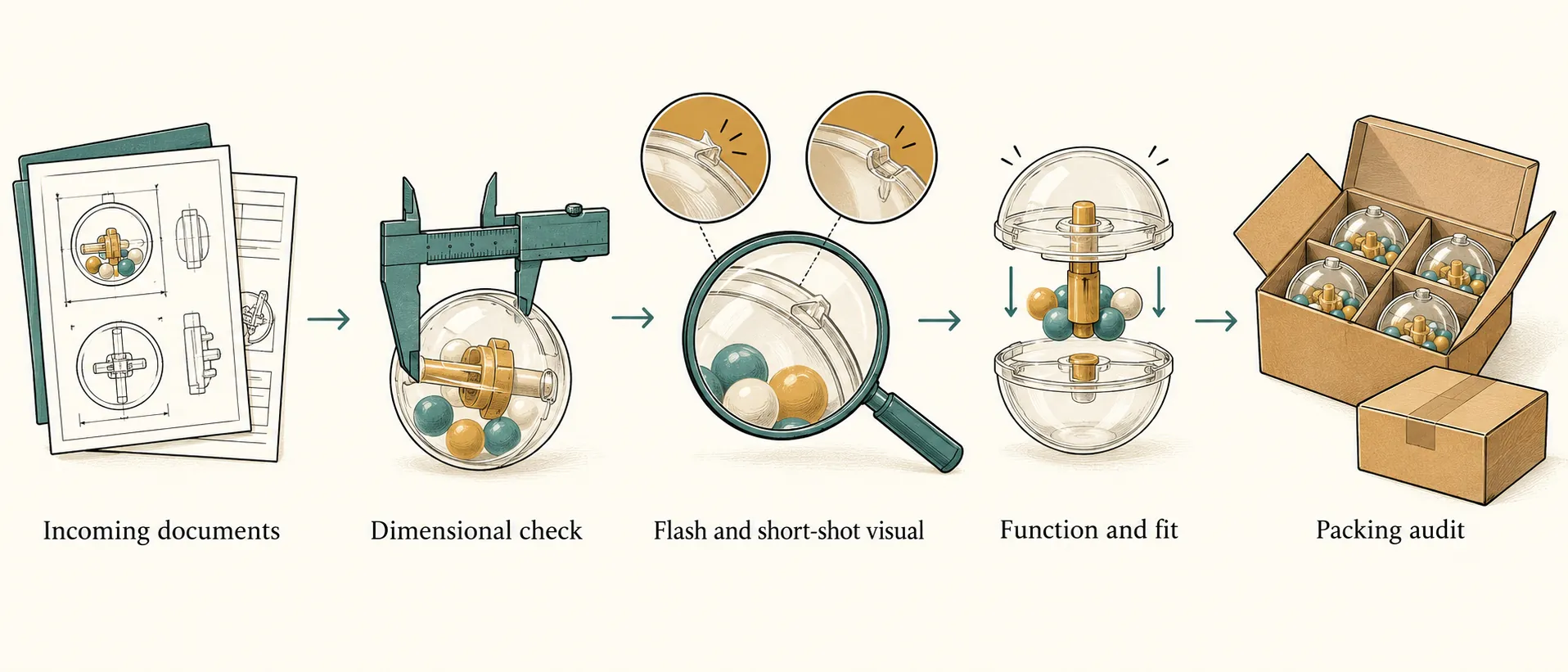
Which parts of the custom rattle insert must stay fixed?
Every characteristic outside the expressly approved customization scope should remain at its identified baseline revision. Permission to change the insert’s color is not permission to change its resin grade, internal contents or enclosure connection.
Define the controlled assembly as the insert, its sound-producing contents, its closure and the enclosing structure that locates or retains it. Mark each characteristic as customizable or fixed. For dimensions, give nominal values and tolerances; for materials and processes, identify the approved grade, formulation or process revision rather than inventing a numerical tolerance.
Freeze the design before releasing production tooling. If a proposed customization also alters a previously fixed characteristic, treat that as a change request—not an informal extension of the original brief. Record the intended age group and use for the specific finished toy; neither a catalog category nor a material name establishes infant suitability.
Custom rattle insert specification
| Assembly identity and customization boundary | Identify the finished-toy model, insert and enclosure part references, drawing and bill-of-materials revisions, and specification date. Name the permitted customizations and the fixed reference characteristics. |
|---|---|
| Insert geometry | Specify overall length, width or diameter, height, relevant wall thicknesses and locating features. Give units, nominal dimensions, tolerances, measurement locations and methods. |
| Enclosure cavity | Specify usable cavity dimensions, seating surfaces, relevant draft and internal obstructions. Assess clearance at tolerance limits, not only at nominal dimensions. |
| Attachment, retention and closure | Identify the insert’s locating and retaining features, engagement dimensions and closure method. Reference the approved assembly procedure and acceptance criteria; do not substitute a visual fit check for retention evidence. |
| Resin and other construction materials | Identify the material used for each relevant component, its manufacturer and grade, and the approved formulation or controlled reference. State restrictions on substitutions and recycled or reprocessed content where specified. |
| Colorant or masterbatch | Identify the approved colorant or masterbatch reference, dosing specification and physical color reference. Require written review of a formulation or source substitution even if the visible color appears unchanged. |
| Sound-producing contents | Specify the internal element’s material, count, dimensions and mass where relevant to the design. Identify the approved sound reference and comparison method; internal contents must not be treated as an interchangeable filler. |
| Production method | Reference the tooling configuration, molding and joining procedures, and controlled process parameters relevant to the insert and enclosure. Record permitted process windows and the changes requiring notification. |
| Intended use and supporting evidence | Record the finished toy’s intended age group, intended use, destination market and applicable evidence references. Link each report to the construction and components it covers. |
Which evidence must match the approved insert and enclosure?
Supporting evidence must match the ordered construction, not merely a similar appearance or a shared material description. Reconcile report model references, photographs, materials, components and age suitability against the current specification and sample.
Watchdog Compliance’s October 25, 2026 Australian retail-safety discussion specifically recommends these product-matching checks and cautions that a report for a similar-looking toy does not necessarily cover the ordered product. Use that as a purchasing check, not as a statement of US or EU legal requirements. Watchdog Compliance
Request material identification and component traceability alongside finished-sample measurements. A resin datasheet describes the material; it does not measure the molded insert or establish the assembled toy’s suitability. For a molded design, review trial evidence for filling, ejection, dimensions, appearance, assembly and process stability before accepting the tool for routine production.
Enclosure approval record
| Record identity | Enter the approval-record number and revision, finished-toy model, insert and enclosure revisions, drawing references, purchase-order reference and review date. |
|---|---|
| Sample identity and provenance | Enter the sample ID, sample date, component lot references, tooling configuration and production method used. Identify retained buyer and supplier reference samples. |
| Specified target versus observed dimensions | For each controlled feature, record the nominal value, tolerance or limits, actual reading, measurement method, instrument reference, sample identity and conformity decision. |
| Specified versus actual construction | Record the required and actual resin grade, colorant reference, sound-element contents, closure and process revision. Link supporting declarations or component records and identify any deviations. |
| Enclosure and functional observations | Record seating, clearance, closure engagement, retention observations and sound comparison against the agreed criteria. Distinguish observations from formal safety-test results. |
| Evidence review | List relevant report and assessment references, the construction they cover, and the reviewer’s coverage conclusion. Document any additional evaluation required for the proposed configuration. |
| Decision and authorization | Record approved, approved with conditions, or rejected, with the reason. Obtain the supplier’s technical sign-off and the responsible buyer approver’s name, role, signature and decision date. |
| Conditions and follow-up closure | Give each condition an identifier, responsible owner, due date and required closure evidence. Record the follow-up result, closure reviewer and closure date. Conditional sample approval is not production release. |
| Production-release link | Identify the current approved specification, enclosure record and reference sample. Record the release decision, authorized production scope, responsible approver and date after release conditions are closed. |
Can an insert pass its dimension check and still require a production hold?
An insert can meet its dimensional specification and still require a hold because an unapproved material or process change is a separate approval issue.
For illustration only, assume a buyer specifies an insert width of 20.00 ±0.10 mm, giving limits of 19.90–20.10 mm. These hypothetical values are not recommended rattle dimensions, safety limits or actual test results.
Sample A measures 20.04 mm but uses a substituted masterbatch. Record the width as conforming, then hold the changed construction pending material identification, an updated color sample and assessment of the supporting finished-product evidence. A dimensional pass does not close the substitution.
Sample B measures 20.15 mm and uses the approved materials. Record a dimensional nonconformity and hold release until the part is corrected and rechecked, or a revised design is formally assessed and approved. Approved materials do not cancel an out-of-tolerance dimension. Neither width result alone establishes enclosure fit or retention.
What must be reassessed after an insert or enclosure change?
| Geometry change | Re-measure affected insert and cavity features and review tolerance-limit clearances. Resample the affected assembly. Close the change with revised drawings, dimensional and fit results, and a documented assessment of relevant test coverage. |
|---|---|
| Material or material-source substitution | Confirm exact material identity and traceability; reassess dimensions, closure and retention where affected. Review whether existing physical and chemical evidence covers the substitution and obtain additional evaluation where needed. |
| Colorant or masterbatch change | Approve an updated color sample and controlled formulation reference. Review applicable finished-product evidence and any affected processing or fit characteristics; visual similarity alone is not approval. |
| Sound-element change | Verify the revised contents against the specification and compare sound using the agreed method. Reassess containment, enclosure interaction and relevant safety evidence rather than approving on sound alone. |
| Enclosure interface or closure change | Recheck seating, engagement, clearance and the affected retention or closure criteria on the assembled sample. Link the insert and enclosure revisions in one approval record. |
| Tooling or process change | Compare the proposed tooling configuration or process with the approved baseline. Check affected dimensions, appearance, joining and assembly characteristics; record the evidence supporting routine production with the revised process. |
When should the buyer release production?
Release production only after the current specification, approved sample, enclosure record and change decisions agree, and all release-blocking conditions have documented closure. Reference that exact revision set in the purchase order rather than relying on an earlier approval email.
Require the supplier to submit proposed substitutions before implementation, identify affected component lots and work in progress, and separate superseded stock from the released configuration. For each change, retain the reason, affected parts, before-and-after revisions, evidence reviewed, decision, approver and date.
Check incoming inserts against the released specification before assembly, including component identity and traceability—not just dimensions. A signed record supports traceability; it cannot by itself reveal an undisclosed substitution. Combine document control with agreed incoming checks and comparison to retained samples.
These records establish a commercial production-release gate. They do not replace the applicable finished-toy safety evaluation, and the coverage of any report follows the tested construction and relevant rules—not a blanket expiry date or a requirement to retest every batch.