Retain a brand-accessible archive linking each approved baby toy design and material revision to its specification, sample identity, approval decision, named approver, date and supporting test evidence. For baby toy OEM/ODM projects, separate the current approved baseline from superseded revisions and unapproved proposals. Accept the supplier handover only when the brand can retrieve that chain and identify which revision applies to the production being released.
The deliverable is an approval and revision archive—not a folder of reports with similar filenames. It should distinguish specified requirements, recorded observations and unresolved checks. Record approval is not product safety certification.
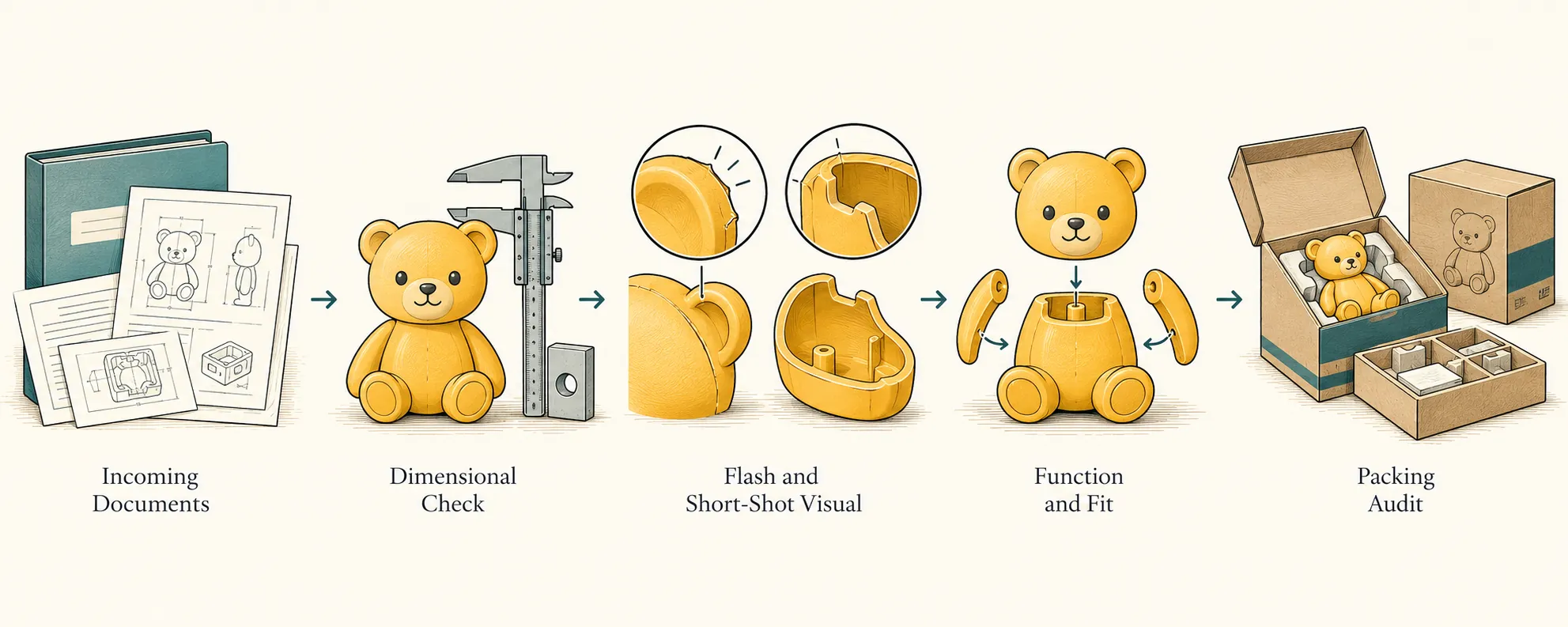
Who owns approval, and what must happen before handover?
Assign one brand-side release owner to accept the record set, supported by product-development approval of the specification and quality or compliance review of the evidence. These are recommended purchasing responsibilities, not statutory job titles; one person may hold several roles, but the recorded decisions must remain distinguishable.
Before development approval, sourcing should agree the handover requirement with the supplier: document scope, revision naming, access rights, record custody, retrieval expectations and responsibility for supplying corrections. An ODM design should still have an identifiable brand-approved configuration; ownership of the underlying design does not replace configuration records.
Establish the baseline. Product development supplies the product identity, component list, intended use, documented age assessment, destination markets, drawings and material requirements. The supplier returns the proposed material specification, relevant declarations, manufacturing-site identity and identifiable samples. Do not infer infant suitability from a catalog category, photograph or material name.
Review the evidence. Compare the supplier's submission and sample observations against the agreed requirements. Quality or compliance records which reports cover the proposed construction and which questions remain open. Keep supplier declarations, technical data sheets, commercial sample checks and product test reports separately identified: they answer different questions.
Record the decision. The designated reviewers sign their respective assessments; the release owner records approval, rejection or hold, with the exact revision and permitted scope. Approval for appearance review is not approval for production.
Complete the handover. The archive custodian checks the index, opens the linked files and confirms that the release package identifies the applicable revision. Deliverables are the approved baseline, signed decision, revision history, evidence links and any closed follow-up records.
What fields should the design-material approval archive contain?
| Product and intended-use identity | Record the brand product identifier, supplier cross-reference, product description, destination markets, intended use and age-assessment reference. Owner: brand product development. |
|---|---|
| Component and material specification | Identify the component, drawing and bill-of-materials revision; specify the material manufacturer and grade where controlled, color, finish and relevant processing requirements. Link the supplier declaration and technical documents. Owner: supplier prepares; product development approves. |
| Specified target versus observation | Keep separate fields for the agreed requirement, observed or reported result, units, evidence reference and review conclusion. Identify whether the observation came from a sample check, supplier declaration or laboratory report. |
| Revision identity and status | Record the revision ID, issue date, predecessor, and status: proposed, under review, approved current, superseded or rejected. Identify the approved baseline separately from the newest uploaded file. |
| Change description and reason | State what changed and why, including affected design, manufacturing process or component source. Link the previous specification, proposed specification and comparison. Owner: supplier prepares; brand technical reviewer assesses. |
| Sample and manufacturing-site identity | Link sample identifiers, dated photographs, physical sample location where retained, manufacturing site and the configuration represented. Preserve relevant batch or lot references when available. |
| Approval basis and report linkage | Link the supplier declaration, full test reports, report IDs, tested sample descriptions, applicable report pages, tests run and reported values or outcomes. Record the review explaining their relevance to this revision. |
| Test and comparison conditions | Retain reported test-method editions, units, specimen conditions and relevant processing conditions. Seek clarification before treating figures obtained under different conditions as directly comparable. Owner: quality or compliance reviewer. |
| Decision, approver and date | Record approve, reject or hold; the approval scope; each responsible approver's name, role and date; and the final release owner's decision. Preserve any signed deviations and their limits. |
| Effective production scope | Identify the order, lot, site or other agreed boundary to which the revision applies. Retain the revision used for earlier production even after a new baseline becomes current. |
| Open actions and closure | Give each unresolved check an owner, required action and due date. Close it with a dated evidence link and the responsible reviewer's acceptance; retain the original issue. |
| Retrieval and retention controls | Record the stable file location, physical sample location if applicable, archive custodian, access permissions, retention rule and relevant language or translation arrangements. |
How should current and superseded revisions be stored?
Keep one controlled current baseline, preserve historical revisions unchanged, and store proposals separately until approved. A practical structure is a master index linked to Current Approved, Revision History, Pending and Rejected, Test Evidence, and Decisions and Closure.
The master index should resolve product identity → component → revision → approval → evidence → production scope. Use stable document references and revision-bearing filenames; do not rely on a folder called “latest.” Shared reports may be linked to several revisions when the documented coverage assessment supports that use.
When a revision is superseded, preserve its approval and effective production scope rather than replacing its files. The current baseline tells the factory what is approved now; the historical archive tells the brand what was approved for an earlier order.
Keep brand-controlled copies of the agreed handover documents, or durable controlled access with an export arrangement. A supplier's promise to retain its own files is not the same as the brand being able to retrieve them. Test retrieval by opening the referenced documents from the index, including archived versions.
This structure supports traceability. It does not, by itself, expose an undisclosed substitution or verify that production matches the approved configuration.
How do two revision handovers compare?
| Handover A: a folder of apparently complete files | The folder contains a signed sample photograph, a material declaration and a test report, but the photograph has no revision reference and the report's sample identity is not linked to the submitted configuration. Decision: hold approval of the affected configuration while the supplier and technical reviewer establish the links. The documents remain potentially useful evidence. |
|---|---|
| Handover B: a controlled revision package | The index identifies the approved revision, its predecessor, the changed component, sample identity, declaration, manufacturing site, report references, coverage assessment, approver/date and effective production scope. Decision: accept the record handover once required reviews and actions are closed. This does not independently establish product safety. |
| A report predates the proposed revision | Do not reject or accept it solely because of its date. Require a documented assessment of whether the tested construction and applicable requirements cover the revised configuration, plus additional evidence or testing where needed. |
When should the brand hold approval?
Hold the affected approval or production release when a consequential requirement cannot be matched to an identifiable configuration, responsible decision or supporting evidence.
Hold for conflicting baselines: the drawing, material specification, sample label and release package point to different revisions, or no record identifies which version is approved for the order.
Require clarification when approval lacks a named approver, date or scope; when a declaration describes only a broad material family rather than the agreed specification; or when a report cannot be linked to the relevant sample, construction or manufacturing site.
Pause comparisons if a missing method edition, unit or specimen condition could change the interpretation of a reported value. Missing detail calls for a targeted correction, not automatic dismissal of every other valid record.
Do not close a follow-up merely because a replacement file arrived. The responsible reviewer must confirm what it resolves, record the closure date and update the release decision. If a condition remains open, state exactly which activity remains blocked.
A missing record does not prove supplier dishonesty or predict failure. It means the brand has not yet completed the specified basis for that approval.
How long should records be retained, and what does U.S. law require?
Set a documented retention schedule for the destination market and the brand's contractual and recall-support needs; do not apply a single global period to every development document.
For the United States, 16 CFR 1107.26 applies to manufacturers of children's products subject to an applicable children's product safety rule. The section originated in the November 8, 2011 rule and was amended on December 5, 2012 and April 30, 2021. The cited eCFR.io page displays an edition dated October 19, 2026; that display date is not an effective date and does not indicate that these obligations were newly introduced then. The section requires copies of Children's Product Certificates identifying the covered products, records of third-party certification tests kept separately for each manufacturing site, and descriptions of material changes in design, manufacturing process and component sourcing together with certification tests run and test values. These are selected requirements relevant to this archive, not the section's entire record list. 16 CFR 1107.26 and source history
The same section requires the records specified in paragraph (a) to be maintained for five years and made available to CPSC on request, in hard copy or electronically. That provision does not prescribe a particular archive application or revision-folder structure.
For records maintained in a language other than English, the rule permits that arrangement if the manufacturer can provide them immediately and translate them accurately into English within 48 hours of a CPSC request, or a longer period negotiated with CPSC staff. Build access and translation arrangements into the handover rather than assuming an English index is sufficient. Cornell LII
The purchasing checklist above is broader than those selected legal requirements. It does not turn every physical-material edit into an automatic retest requirement, and a new internal revision identifier does not by itself establish the need for a new test. Record the technical assessment and required evidence for the actual change.
U.S. retention provisions are not EU or global requirements. Confirm the applicable market rules and responsible legal entity separately. A complete design-material archive supports a defensible explanation of what was reviewed and approved; it is neither a complete compliance file nor proof that the toy is safe.